
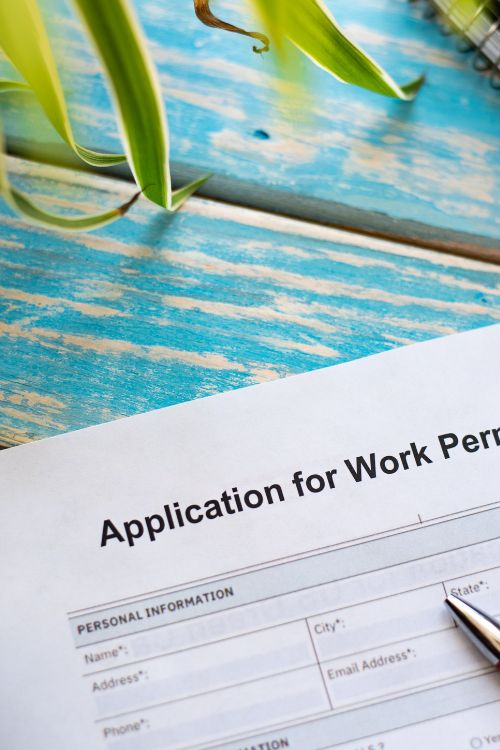
You've found the right candidate, the recruitment is moving forward — and then the question comes up: do you need to apply for a work permit?
This is often where companies lose time. Between the employee's nationality, visa type or residence permit, status change, or new application from abroad, the answer isn't always straightforward.
Yet a misreading of the file can delay the hire or jeopardise the employee's start date.
In France, any employer wishing to hire a foreign national must first verify whether that person is authorised to work.
In some cases, the employer must submit a work permit application themselves. In others, they are exempt — because the employee already holds a document that grants them the right to work.
The principle: the employer must verify whether the employee can work in France
When is the employer required to apply for a work permit?
- La situation nécessite une autorisation préalable dans le cadre d’une embauche depuis l'étranger, d'un recrutement ou d'un changement de statut en France.
- The employee does not yet hold a document authorising them to work in France (e.g. a foreign student).
- The document held does not cover the intended salaried activity.
When is the employer exempt from applying?
Les visas ou titres de séjour dispensés d'autorisation de travail de fait
The employer does not need to apply for a work permit if the employee already holds a document that grants them the right to work.
C’est par exemple le cas, de certains VLS-TS ou cartes de séjour “vie privée et familiale”, les titres "Recherche d'emploi création d'entreprise" ou encore les cartes "résident" qui permettent de travailler sans demande complémentaire de l’employeur. (Liste non-exhaustive)
Les visas ou titres de séjour Talent
Certaines cartes de séjour “Talent” dispensent également l’employeur de demander une autorisation de travail.
Il s'agit notamment des titres de séjour talent-salarié qualifié, talent-carte bleue européenne, ou encore certaines autres cartes talent ouvrant droit à l’activité salariée.

Nationals benefiting from freedom of movement
Finally, a work permit is not required for nationals benefiting from freedom of movement — including individuals from the EEA, Switzerland, Monaco, Andorra, or San Marino.
Important: do not confuse residence permit with the right to work

Which situations require particular attention?
Certain cases call for extra vigilance:
- Employees already in France holding a status that does not automatically grant the right to the intended employment
- Status change situations
- Hires from abroad
- Minors aged 16 to 18, for whom a work permit is mandatory — including apprenticeship and professionalisation contracts
- Certain foreign nationals who, by virtue of their nationality, are subject to a specific framework (bilateral agreement or treaty)
What conditions does the administration review?
A work permit is not granted automatically. It is issued when the application meets a set of cumulative conditions relating, in particular, to the role being offered, the employer, the occupation, the required level of qualification, and the salary.
The French Labour Code notably requires that the proposed salary comply with the minimum wage (SMIC) — or, if more favourable, with the minimum pay set out in the applicable collective agreement. It also provides for grounds for refusal linked, for example, to certain criminal convictions or serious administrative sanctions against the employer, the client company, the user company, or the host company.
Key takeaways
If you are recruiting a foreign national, it is best to verify the correct procedure before moving forward.
A misreading of the file costs time. A proper assessment, on the other hand, allows you to secure every step that follows.
Have a question about whether a work permit is required?
I can help you assess the situation and identify the right procedure.
You may also like:

Mission de courte durée en France : est-ce que l’autorisation de travail est nécessaire ?
Un salarié étranger vient en France pour une mission de quelques jours ou quelques semaines : faut-il obligatoirement demander une autorisation de travail ? Non, dans certains cas. Le Code du travail prévoit une dispense pour certaines activités salariées exercées en...

Étudiant étranger en France : peut-il travailler pendant ses études ?
Vous souhaitez recruter un étudiant étranger pour un emploi à temps partiel “un job étudiant” ? La présence d'un titre de séjour portant la mention « étudiant » ne suffit pas, à elle seule, pour déterminer les démarches que l'employeur devra effectuer. En principe, un...

Recruter un étranger déjà titulaire d’un titre « salarié » : faut-il publier l’offre d’emploi ?
Vous souhaitez recruter un candidat étranger qui réside déjà en France et possède une carte de séjour portant la mention « salarié ». Faut-il, avant de demander son autorisation de travail, publier l'offre d'emploi pendant trois semaines et démontrer que vous n'avez...

Renouvellement du titre de séjour d’un salarié étranger : que doit vérifier l’employeur ?
Le titre de séjour de votre salarié étranger arrive prochainement à expiration. À première vue, la suite semble simple : le collaborateur dépose sa demande de renouvellement et transmet ensuite son nouveau titre à l’entreprise. En pratique, suivre uniquement la date...

Salarié étranger : quelles démarches après son arrivée en France ?
L’autorisation de travail, lorsqu’elle était nécessaire, a été obtenue. Le visa a été délivré. Votre collaborateur vient d’arriver en France et s’apprête à prendre son poste. La procédure ayant permis son recrutement et son entrée sur le territoire est donc en grande...

Formation civique de l’OFII : comment se déroulent les 4 journées du CIR ?
Vous avez signé un Contrat d’intégration républicaine (CIR) et reçu une convocation pour suivre la formation civique de l’OFII ? Cette formation constitue l'une des principales étapes du parcours d'intégration républicaine. Depuis le 1er août 2025, elle représente 24...

Convocation de l’OFII : comment se déroule votre premier rendez-vous ?
Vous venez de vous installer en France et avez reçu une convocation de l’OFII ? Cette étape peut susciter de nombreuses questions : pourquoi êtes-vous convoqué ? Quels documents faut-il apporter ? Allez-vous passer un test de français ? Que se passe-t-il après le...

Contrat d’intégration républicaine (CIR) : qui doit le signer et quelles sont vos obligations ?
Vous venez de vous installer en France et avez reçu une convocation de l’Office français de l’immigration et de l’intégration (OFII) pour signer un Contrat d’intégration républicaine, plus couramment appelé CIR ? Ce contrat constitue l’une des principales étapes du...

Étranger en France : quelles démarches après votre arrivée ?
Obtenir son visa pour la France constitue une étape importante d’un projet d’installation. Mais contrairement à ce que l’on pourrait penser, les démarches ne s’arrêtent pas à l’arrivée sur le territoire français. Validation du visa, démarches auprès de l’OFII, contrat...

Niveau de français requis pour un titre de séjour pluriannuel : ce qui change en 2026
Depuis le 1ᵉʳ janvier 2026, la première demande de carte de séjour pluriannuelle (CSP) ou de carte de résident (CR) est conditionnée à la justification d'un niveau de français plus élevé qu'auparavant. Cette exigence s'ajoute à l'obligation de réussite à l'examen...